


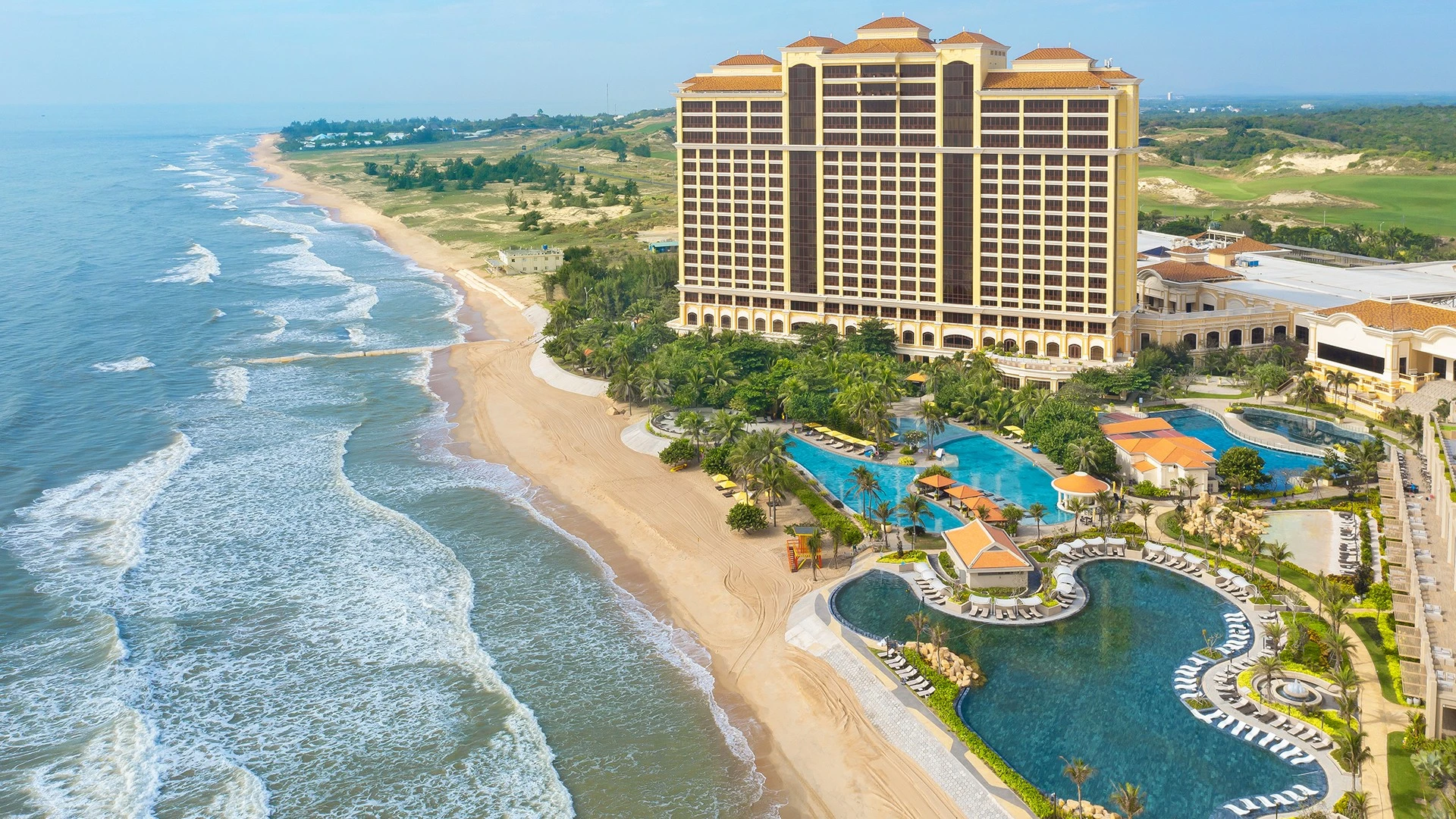
Casino access for Vietnamese nationals at The Grand Ho Tram resounds far beyond the beachfront resort southeast of Ho Chi Minh City (HCMC). It’s a transformational moment for Ho Tram and southern Vietnam, poised to catapult both into the top tier of Asian gaming destinations.
“Vietnam is among the fastest-growing economies in Southeast Asia, and the current administration is keen to sustain this momentum through strategically introduced initiatives, including the recently approved pilot programme for local gaming at selected locations including The Grand Ho Tram,” Steve Wolstenholme, independent director of Ho Tram’s parent company, Asian Coast Development Ltd, and former president and CEO at Hoiana, one of Vietnam’s three beachfront integrated resorts, says.
Since Ho Tram opened in 2013, the company line was that its success did not depend on eliminating the foreigner-only casino restriction. “While the official narrative at the time often suggested that local play was not critical to financial viability, those of us running the operation understood the practical reality,” former Grand Ho Tram president 2014-15 Shaun McCamley says. “A controlled, well-regulated local gaming component would have driven higher visitation, strengthened non-gaming spend, and provided the consistent revenue base needed to support a resort of that scale.”
Fundamental reset
“Local play fundamentally changes Ho Tram’s business mix,” Fortuna Investments Worldwide partner Tim Nguyen says. “With access to qualified local players from HCMC and the southern provinces, Ho Tram can build a much deeper mass and premium mass base, which stabilises revenue and reduces reliance on volatile junket style play.”
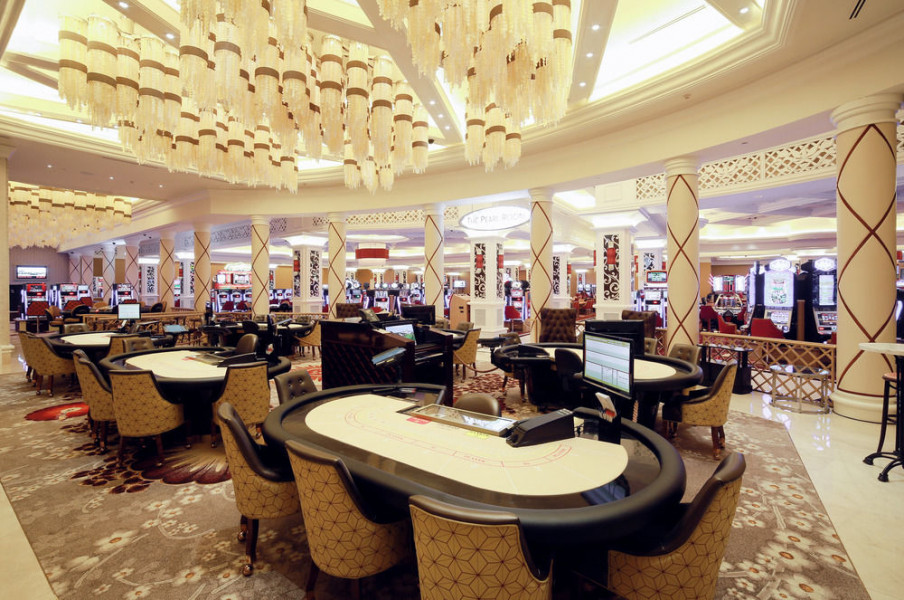
“Local play fundamentally reshapes Ho Tram’s market position and its relationships with existing player segments,” McCamley says. “Rather than diluting the current expat, Viet Kieu [Vietnamese with foreign passports] and foreign VIP base, it actually strengthens the overall ecosystem. Local players bring year-round, repeat visitation – the kind of frequency that builds energy on the gaming floor, increases volume across mass and premium mass and makes the resort feel more vibrant and in demand.”
“In competitive terms, Ho Tram becomes a genuine regional IR competitor rather than a niche beach resort with a casino attached,” Nguyen says.
“With local play approved, it is now time to dust off long-forgotten plans to expand [Ho Tram’s] gaming floor because, in its current configuration, with 90 tables and 500 slots, the casino probably does not have the capacity to accommodate a surge in demand,” Klebanow Consulting principal Andrew Klebanow says.
Trial by seaside
In late November, Vietnam’s government granted a five-year pilot programme for local play at Ho Tram and, when opened, Van Don near Ha Long Bay in northern Vietnam. To qualify, players without foreign passports must prove monthly income of at least 10 million Vietnam dong (VND; US$380) and pay an entry fee of VND1 million for 24 hours or VND25 million per month.
The government also granted permanent admission for qualified local players to Corona Resort and Casino on Phu Quoc island, where a pilot programme started in 2019 expired at the end of 2024.
“Corona, in my view, will always struggle to unlock the full value of local play given its relatively remote island location and limited natural feeder markets,” McCamley, now managing director of EuroPacificAsia Consulting, says. “By contrast, Ho Tram is just over an hour’s drive from Ho Chi Minh City, a commercial hub of over 10 million people. With a properly structured and stable local play policy, Ho Tram on its own could transform the country’s gaming landscape, both in terms of visitation and GGR.”
“With full local play across a handful of integrated resorts in key hubs – HCMC/HCMC-catchment, Hanoi/Ha Long, Da Nang/central coast – Vietnam could realistically sit in the same conversation as Singapore or the Philippines over the medium term, assuming tax, product and infrastructure are competitive,” Nguyen says.
Great leap forward
By any calculus, Vietnam reaching US$5 billion annual gross gaming revenue seems far-fetched at first glance. Industry sources estimate Vietnam’s GGR last year around US$300 million and rising to near US$400 million this year with local play at Ho Tram and Corona.
McCamley’s “informed market view” tabs last year’s GGR for Ho Tram and Corona around $100 million, split evenly between table games and slots. He estimates local play adding 20-25% to table game totals, “assuming Ho Tram are effective in managing the current difficult entry requirements”.
GGR for foreigner-only slot clubs, around a dozen in Ho Chi Minh City and others scattered around the country, is estimated at $200 million. “The slot clubs have carved out a very nice and profitable niche, serving the expatriate community,” Klebanow says. “I do not see expatriates shifting their play to Ho Tram.”
“HCMC slot clubs have established customer bases that have already shown that they tend to prefer to play in HCMC rather than travel to Ho Tram.” Ho Tram Project Company general director 2010-16 Colin Pine says.
“While slot clubs will retain their convenience-driven customers, Ho Tram will take share from the mid- to premium mass segments seeking a more complete gaming and entertainment offering,” McCamley says.
Head for the border
For players in Ho Chi Minh City, travelling to Bavet, the closest border casino cluster in Cambodia, takes about as long as travelling to Ho Tram. “A portion of low- to mid-tier players will prefer a legal domestic option where they don’t have to cross a sometimes chaotic land border and worry about safety or grey area legality,” Nguyen says,
“VIP and very entrenched customers, especially those with longstanding relationships, credit lines and side arrangements, may remain loyal to border properties in the short term. But even for those players, the existence of a serious domestic option shifts bargaining power over time.”
Industry sources say local play at Ho Tram may negatively impact NagaWorld in Phnom Penh, a roughly six-hour drive or one-hour flight from HCMC, but not affect Singapore or Macau. “Those high value Vietnamese gamers that travel outside of Vietnam to game will likely continue to do so because of a combination of preference and a likely desire to manage their profile inside of Vietnam,” Pine says.
Even assuming Vietnamese play in foreign casinos matches GGR inside the country, that’s still well below the first rank of Asian gaming markets. But economically, Vietnam is virtually identical to a top tier market.
Economic lookalikes
Vietnam is a near statistical twin of the Philippines, believed to have overtaken Singapore as the number two gaming market in Asia, even before the archipelago’s online play boom last year.
In 2024 Vietnam and the Philippines ranked 34 and 35 globally in GDP, US$476 billion and $462 billion. Other economic statistics are similarly close. However, McCamley contends published data understate Vietnam’s spending power.
“In reality, Vietnam’s underground and informal economy is both vibrant and substantial, particularly in the major urban centers and coastal destinations. Disposable income, private enterprise and cash-based wealth are far more prevalent than headline GDP figures suggest, and this disconnect is often missed by external observers and international operators.
“From a destination and local play perspective, Vietnam has several advantages that remain underappreciated. Domestic tourism is strong, entertainment spending is culturally embedded, and there is a growing cohort of middle- and upper-middle-class consumers with both the time and means to travel domestically. While comparisons with the Philippines are valid on paper, Vietnam’s income distribution, social mobility and urban concentration arguably make it a more compelling long-term destination play, especially now that local participation has been expanded.”
Tourism profile rising
There’s another statistic that suggests Vietnam has a higher GGR ceiling than the Philippines. In 2025, the Philippines reported 5.9 million visitor arrivals, down from its high of 8.3 million in 2019. Vietnam tallied a record 21.2 million arrivals last year, up 20% from 2024.
Leading source markets, China with 5.3 million visitors, South Korea with 4.3 million and Taiwan with 1.2 million, accounted for more than half of Vietnam arrivals. Those markets, along with other top 10 sources the US, Japan, India and Russia, hold potential to boost gaming revenue.
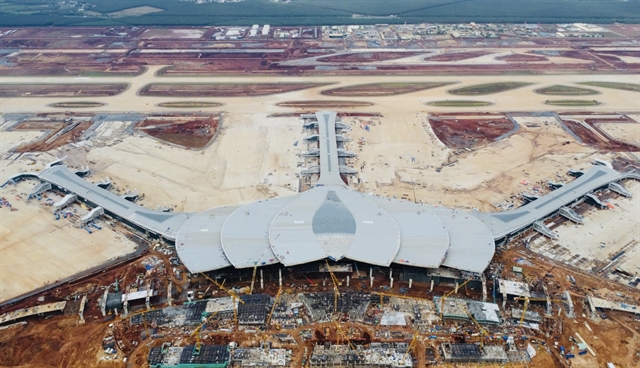
Ho Tram’s international profile will soar when Long Thanh International Airport opens to commercial flights later this year. Fifty kilometres from Ho Tram, Long Thanh will provide an alternative to Tan Son Nhat, a drive more than twice that distance that runs two and a half hours through the teeth of Ho Chi Minh City traffic.
Welcoming local players
Ho Tram declined to detail plans to accommodate local players. Ho Tram leadership alumni recount how they would have responded to a local play pilot.
Colin Pine says he would have aimed to accelerate construction of Ho Tram’s second hotel tower. “This would have included several of the elements which have been incorporated into that now-completed tower – more local-friendly dining experiences, other entertainment, cinema, bowling alley, kids’ play zone and the like,” Pine says.
“We would have prioritised introducing a well-structured loyalty and rewards programme tailored specifically to the Vietnamese local market,” McCamley, now CEO of online gaming provider GameWorkz, says. “This would have allowed us to build long-term customer value, increase visitation frequency and create data-driven personalisation – all fundamental to competing effectively once local play was permitted.
“We also would have expanded and optimised the slot product mix, bringing in machines and game types more in tune with local expectations and player preferences. This is an area where Vietnam’s potential has been consistently underestimated, and aligning the floor to domestic demand would have yielded significant uplift.”
Entertainment Above & Beyond
Pine, currently CEO of Royal Canary Corp in Vietnam, an investment company focusing on hospitality, says he would have also expanded transportation capacity for players from Ho Chi Minh City, adding, “We may have invested in a dedicated performance venue sized suitably to the planned key count.”
“High-calibre, headline international acts are exactly the type of entertainment that resonates with Vietnamese audiences and receives strong government backing,” McCamley says. “When I was at Ho Tram, we brought in [London electronic music group] Above & Beyond, attracting over 10,000 local attendees. It was a landmark moment that elevated the property’s profile nationwide and demonstrated how world-class entertainment can drive local engagement and visitation.”
Ho Tram currently offers 1,300 guest rooms in three hotels along a portion of its 2.2 kilometre beachfront. Wall Street hedge fund figure Philip Falcone owned Asian Coast Development when it opened in April 2013 with single hotel tower, a month after MGM Resorts International cancelled its management agreement for a putative MGM Grand Ho Tram.
Wall Street trading
In 2019, Falcone sold Ho Tram to US private equity firm Warburg Pincus and minority partner VinaCapital, a Vietnam-focused investment group. New ownership brought a long-term strategic outlook to the property, according to Grand Ho Tram CEO Walt Power, who came aboard in early 2020 after 18 years in Macau.
The partners formed Lodgis Hospitality Holdings and enlisted IHG Hotels and Resorts to rebrand the original tower as The Grand InterContinental Ho Tram and operate the long-planned second tower, which opened in January 2022 as Vietnam’s first Holiday Inn Resort. In 2023, Lodgis’ wellness-themed brand Fusion debuted Ixora, selling villas and rooms to investors and managing their rental as guest accommodations.
The resort features The Bluffs Grand Ho Tram, a links course designed by former world number one golfer Greg Norman. The Bluffs was Vietnam’s first course selected for Golf Digest’s global top 100.
Ho Tram’s casino has 90 tables and about 500 slots and ETG terminals. Amid competition from Ho Chi Minh City slot clubs, management regularly updates electronic offerings. All play is in US dollars, though local players must buy in and cash out in Vietnamese dong.
New at the Strip club
In May Lodgis announced a US$1 billion expansion for the resort complex.
Spanning 35 hectares (86 acres), the expansion will lift Ho Tram’s room count above 9,000 and total project investment to US$4 billion, the minimum stipulated on the investment certificate granting Ho Tram’s gaming licence. According to Lodgis, the project will include five-star hotels and villas, a wellness and medical spa, multi-sport and entertainment complex, amusement park and MICE facilities.
These additions promise to realise the long held ambition of creating a Ho Tram Strip. Local play puts a firmer foundation under those ambitions.

Muhammad Cohen is a former US diplomat and current iGB Asia editor at large. He has covered the casino business in Asia since 2006, most recently for Forbes, and wrote Hong Kong On Air, a novel set during the 1997 handover about TV news, love, betrayal, high finance and cheap lingerie.