


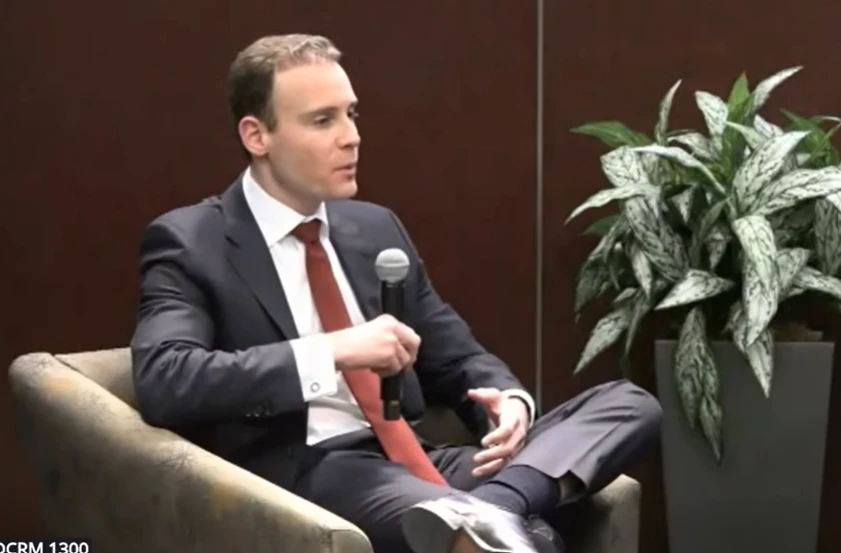
Newly appointed CFTC Chairman Michael Selig gave a passionate defense of prediction markets and sports event contracts Thursday, in comments given during a joint “harminisation” event with Securities and Exchange Commission Chairman Paul Atkins held at CFTC headquarters in Washington DC.
In a wide-ranging speech about the future of US financial markets, Selig stressed the need for innovation and regulatory overhaul. Most of his comments pertained to cryptocurrency, which has become a top priority under President Trump’s administration. But before concluding his nearly 20-minute remarks, Selig confirmed the commission will support prediction markets moving forward.
“It’s time for clear rules and clear understanding that the CFTC supports lawful innovation in these markets,” Selig said. “Consistent with my commitment to fostering responsible innovation in crypto asset markets, I will continue to support the responsible development of event contract markets and the important role they play in the broader financial system.”
Sports event contracts on prediction markets have rankled the gaming industry from all sides, including digital and land-based stakeholders. The controversial exchanges are the subject of several ongoing lawsuits from states, gaming regulators and tribal entities across the US. Previous administrations had squashed the rise of event contracts on both politics and sports, which Selig and others have referred to as “regulation by enforcement”.
The CFTC chief laid out four points of action related to prediction markets, with the first being to reverse course on previous guidance. Selig is ordering the withdrawal of both a proposed rule to prohibit political and sports-related event contracts from 2024, as well as an internal advisory note about prediction markets the commission issued last September.
“While the advisory was issued at the staff level with the intent of bringing clarity and awareness to the litigation, it’s instead contributed to uncertainty in our markets,” Selig said.
Selig to reverse guidance, develop new rules
Selig largely avoided the topic of prediction markets during his Senate confirmation hearing last year. He said it was a matter “for the courts” to decide, though his comments Thursday suggested unequivocal support.
“These markets are not new,” Selig said. “They’ve operated within the CFTC’s regulatory parameter for more than two decades now. But despite their history, many view them as novel or unsettled, and that uncertainty has not served our markets well, nor has it served the public interest.”
The next step will be to “move forward with drafting an event contracts rulemaking” plan. Selig said the CFTC’s existing framework “has proven difficult to apply, and has failed our market participants”.
The only way to solve this, he said, was to establish “clear standards for event contracts that provide certainty” to stakeholders. Notably, existing CFTC regulations prohibit contracts involving “gaming”, though prediction markets have successfully argued in court that event contracts are legitimate financial products.
Selig also directed staff to “reassess the commission’s participation in matters currently pending before the federal, district and circuit courts”. His comments echoed the federal jurisdiction arguments made by Kalshi and others in their various suits.
“When jurisdictional questions are at issue, the commission has the expertise and responsibility to defend its exclusive jurisdiction over commodity derivatives,” he said.
Increasing collaboration between CFTC, SEC
Selig’s final point regarding prediction markets stressed coordination and efficiency with the SEC. These efforts will “draw clear lines between certain commodity and security options”, he asserted. Collaboration between the two agencies has become a popular topic, including an event last year that featured the CEOs of Kalshi and Polymarket.
The general trend appears to be for the SEC to shift some of its financial oversight to the CFTC, which has historically been much smaller than the former. Newer financial products like crypto and prediction markets do not exactly fit into the SEC’s remit, and the CFTC has become the preferred agency to take that mantle.
Before the event began Thursday, the Senate Committee on Agriculture, Nutrition and Forestry advanced the Digital Commodity Intermediaries Act, which would give the CFTC new authority to “regulate digital commodities and strengthen consumer protections for the emerging market”, per a release.
The bill, which narrowly passed the committee in a 12-11 party-line vote, includes:
- New definitions for digital commodities
- Consumer protections, including “conflict of interest safeguards”
- A new registration regime that facilitates “onshore liquid and resilient regulated markets”
- SEC-CFTC collaboration requirements
- Protections for software and technology companies
- New funding for the CFTC “to stand up a spot market regulatory regime”
It is designed as a companion bill to the crypto market structure legislation currently stuck in the Senate Banking Committee. Both measures would need to advance past committee and combine before reaching a full Senate vote.
Selig and the SEC’s Atkins referenced the pending legislation several times, with the sentiment that passage is inevitable. In any case, Atkins praised Selig and his potential new set of responsibilities.
“There is no one that I’d rather have at the helm of the CFTC, as our markets move on-chain,” Atkins said.
Regulated gaming, prediction markets groups stake ground
As prediction markets have become more prevalent, their rise has created a deepening rift within the gaming industry.
Digital-leaning companies, particularly bookmakers like FanDuel, DraftKings and Fanatics, joined the segment largely to defend territory in unregulated sports betting markets including California and Texas. Others, however, have gone in the opposite direction.
Several companies left the American Gaming Association because of prediction market ties, including the three companies above, and suppliers Sportradar and OpenBet. The AGA has become a vocal opponent of prediction markets and publishes a running total of state betting taxes lost since their proliferation. That total will eclipse $400 million in the coming days.
In light of this impact, the AGA also teamed up with the Indian Gaming Association to spotlight the effects prediction markets have had on tribal gaming. The two groups penned a joint letter to Congress imploring lawmakers to include language banning sports event contracts in the crypto legislation. Neither the AGA nor IGA responded to a request for comment Thursday.
The Sports Betting Alliance, a lobbying group that includes both bookmakers and prediction market operators, declined to comment.
The Coalition for Prediction Markets, which includes Kalshi, Robinhood and Underdog, released the following statement:
“We applaud Chairman Selig’s statements that the CFTC has ‘the expertise and responsibility to defend its exclusive jurisdiction’ over event contracts, and we welcome the participation of the Commission in matters where that jurisdiction is under attack. By withdrawing uncertain guidance around sports-event contracts and committing to undertake comprehensive rulemaking, the Commission takes a key step to foster market clarity, responsible innovation, and trust in American markets. We look forward to working with the CFTC to continue that important mission.”